Showing posts with label Cricket Tips. Show all posts

Friday, December 3, 2010

Ways to “Get Out” In Cricket for a Batsman


Most common ways to get out as follows:

1. Bowled:-If a bowler manages to get a ball through and knock off the bails (The two wooden bits resting on the top of the Stumps) it is called Bowled.

2. Stumped:- When a batsman comes down the crease to hit the ball, and if he misses the ball there is a chance of getting out by stumping with the ball by the wicket keeper.

3. Leg Before Wicket (LBW):- When a batsman obstructs the ball from hitting the stumps with any part of his body (Usually Pads) other than bat. It is called LBW and the decision is taken by the umpire after the appeal by the bowler.

4. Caught:-Being Caught is most common way of getting out for a batsman. A batsman is out caught when a fielder catches the ball directly off the bat, before it has hit the ground.

5. Run Out:- When a batsman is going for runs between the wickets, but fall short of the batting crease when the stumps are broken by the fielding team.


Uncommon ways of getting out in the game of cricket as follows:

6. Handling The Ball:-When a batsman tries to obstruct the ball with his hand he can be got out. They can only knock the ball from rolling back on to the stumps with pads, feet or bat.

7. Timed Out:-When a batsman got out and if the next batsman fails to reach within 3 minutes, the umpire can give him/her out. This is the rarest form of getting out in type of cricket.

8. Hit The Ball Twice (Double Hit):-When a batsman hit twice a ball while playing a shot. This kind of dismissal is very rare and the batsman can go out only if the second hit is deliberate.

9. Hit Wicket:-This dismissal happens when a batsman himself knocks their stumps over while playing a shot or when leaving a delivery.

10. Obstructing The Field:-The umpire can give a batsman out if he feels the batsman has got in the way of a fielder who is about to take a catch or attempt a run out.

Thursday, August 5, 2010

Cricket Fielding Tips


When fielding during cricket there are many things to think about and consider depending on where you are fielding. This brief article will look at a few essential cricket fielding tips which you can incorporate into your game to improve your fielding.

Where ever you are fielding you should always be on the balls of your feet so you can react and change direction quickly. If you are caught flat footed you'll be slower off the mark and potentially give away more runs.

Try to anticipate where ball will go; you can do this by carefully watching the batters shape and movements. This may be a little difficult at first but after a bit of practise will become second nature and you'll react much quicker to any shots coming your way and field better as a result.

When you are fielding close to the boundary and have to throw from the deep, try to aim your throw just above the keepers head and the ball should drop nicely in to his gloves, provided you have a relatively strong throwing arm.

When catching close to the wicket, such as in the slips, gulley or short leg, make sure you stance is correct with your feet shoulder width apart or slightly wider. Spread your weight evenly across both feet, resting lightly on the balls of your feet, with your knees flexed. Keep your hands together, close to the ground with your fingers pointing down. Keep your head up with your eyes level and stay alert.

When catching the ball in close, watch the ball all the way into your hands, allowing the ball to come to you; don't try to snatch at it. 'Give' with the ball as you catch, cushioning the impact. When catching in the deep, try and catch the ball at eye level and cushion the ball into your chest.

The ball can come to you at any time so it is really important you stay alert and awake so you can stop that vital run or take a match winning catch.

These are just a few cricket fielding tips that you can incorporate into you game; there are many more cricket fielding tips for specific aspects of fielding. However these are the general cricket fielding tips I've found to be the most useful.

Cricket Batting Tips-Foot Work

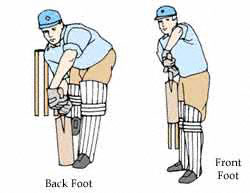
When batting in cricket it is essential to have excellent footwork. As good foot work is the basis for achieving excellence in cricket and is the foundation for good batting technique.

Foot work is absolutely necessary as all successful strokes start with effective batting footwork.
If you watch great cricketers like Brian Lara, Michael Vaughn, Ricky Ponting, Sachin Tendulkar, all of these amazing batsmen have outstanding footwork, often when these types of cricket players don't perform it is simply due to lack of footwork.

Good footwork allows you to time the ball well and place the ball in gaps. It gets you in the optimum position to hit the ball, so you can hit it where you want and with ease.

If you have been struggling to play a particular shot for some reason it could be due to poor footwork causing bad timing and body positioning.

With faster bowlers it is even more essential to have excellent fast and precise footwork, so that you can get into a balanced position, in-line with the ball, so you can play the ball with control.

Getting quickly into position through footwork therefore is very important.

The more you practice your footwork against both fast and slow bowlers the easier you will gradually find it. Many players do what we call trigger movements just before the bowler releases the ball, this helps get the feet moving into position and into line much quicker and easier, especially against faster bowlers.

Next time you watch a game of cricket on TV watch the batsmen's feet really closely as the bowler is about to deliver you'll see these small 'trigger movements'; small foot movements, which help the batsmen get in position and inline early.


As a batsman it is absolutely necessary to develop your foot work and foot movement, as all excellent strokes start with effective and efficient footwork.

Tuesday, February 9, 2010

Catching tips

Everyone's heard the phrase: 'Catches win matches'. And you found out whoever told you that phrase whether it be your coach or your Dad, were right. Cricket is about scoring runs and taking wickets, that's how you win. So what's the most common way batsmen get out? Caught. If you drop em you don't win - that's pretty much it.

So in my next cricket tips blog I'm going to cover the basics on catching.

There's two different types of catches - outfield and infield catches. The only main difference is that outfield catches are higher and require some distance to be covered, whereas infield catches are flatter, faster and require little/any movement at all. However, there is a similarity between catches and that is the positioning of the hands (the most important body part involved in taking a catch - good idea not to forget that). Here are some things to remember:

1. Relax - Keep your hands 'soft'. This will help in preventing the ball caning the palms of your hands which normally result in some sort of excruciating pain and a dropped catch.

2. Give - Give with the ball. As the ball enters your hands it isn't a good idea to just leave your hands where the ball is going to land - this also means pain and a dropped catch. What you want to do is to reduce the amount of force the ball has on your palms, so by bringing the arms towards the body during the catch, you aren't going to feel the full force of a flying cricket ball.

3. Fingers - One of the basic principles of catching. For low catches below the chest, the fingers are pointing down when in its cupped position, whereas the fingers should point up for those catches above the chest.

4. EYES ON THE BALL! Coping one to the face isn't something nobody enjoys. Enough said.

Tips for Cricket Captain

Like all team sports, the captain is responsible for the function of their side both on and off the field. In cricket, the captain plays a very active role in the 'playing' of the game - their decisions on the field can directly affect the outcome of the innings, thus bad decisions will lead to disaster and good ones will often lead to victory. Cricket captains, whether it be Ricky Ponting or your local club side usually have the most experienced and extensive knowledge about the game, as decisions must be made on the spot according to particular circumstances in the game. For instance, the captain must be able to determine when a field change is required, or to be able to set the right field for the particular batsman on strike. Also, the captain plays an active in selecting bowlers and the batting order of the innings - which again is another integral facet in the game of cricket.

The captain must know when to attack or defend, and set appropriate fields or send in an appropriate batsman for the given situation. For example, a captain may send in a powerful hitter ahead of a more conventional batsman in order to increase the run rate. Also, he/she must be able simultaneously perform at a high level consistently, whilst also monitoring the progess of the team and opposition and make changes accordingly.

Some basic decisions a captain may make include:
a) Setting a defensive field: This sees the fieldsmen spread out on the field, with the majority positioned around the boundary in order to stop batsmen who are hitting the ball powerfully. This is usually the case when trying to restrict as many runs as possible; or when a batsman has been in for a long period of time and is timing the ball perfectly; or a designated hitter is sent in to bolster the run rate of the batting side.

b) Setting an attacking field: This sees the field come close to batsman, basically encircling him/her in order to create pressure and to force mistakes. This ploy is often used on batsmen who are struggling to score or have just come in to bat.

c) Sending in a nightwatchman: A nightwatchman is a lower-order batsman who is deliberately sent in late in the day in order to protect a top-order batsman from being dismissed before the end of play. A perfect example of a successful nightwatchman would be Jason Gillespie. Nightwatchmen are usually told to defend and normally have very solid defensive techniques. This may backfire the following day if the nightwatchman remains in, as the run rate will fall due to the lack of runs, or if the nightwatchman is dismissed before the end of day's play.

d) Sending in a 'pinch-hitter': Here, the captain sends in a powerful hitter in order to score quick runs. This usually occurs at the end of an innings in order to 'pinch' extra runs by hitting fours or sixes.

e) Declaring: A captain may decide to declare an innings (end an innings) before all batsmen are dismissed in order to achieve a result in the game. This typically occurs when a side has amassed a comfortable amount of runs, and continuing to bat will only give less time to bowl the chasing side out.

To add to this, the captain must also complete a captain's regular duties, such as sustaining team discipline and ensuring player's are mentally ready for performance.

So as you can see, cricket is not merely hitting a ball with a bat, it is a game of thought and intuition. The captain is one person who can influence whether or not a team will win or lose a cricket match - so the better the cricket mind, the better the captain and the better the side.

Friday, October 23, 2009

Cricketing Tips

Cricket is a game of skill, strength and stamina. Any conditioning program needs to take into account these three factors so that a player can improve his performance. Proper conditioning and coaching programs help the players with a natural ability to perform well and reduce the risk of injury and fitness problems.Before playing the game, it is important for the players to undergo a warm-up session and a regular stretching routine. This helps the bowlers and the batsmen to get ready for the action and stay fit despite long playing hours. Along with strength and fitness, the players also need to work on their skills and technique.
Batting: A good batsman is one who concentrates hard and tries to stay at the crease for longer duration and at the same time scores runs. In order to survive for hours against a quality bowling attack and also scoring runs, the batsman needs to mix caution with aggression. He should have good eye or reflexes combined with an ability to stay focused. The strength and the technique to play shots is also important.
Fielding: Fielders need to be on the field and remain alert to stop the ball, chase it, racing towards the boundary. At times, they need to jump in the air, dive along the ground and catch the ball at a high speed. They cannot afford to get tired. Fielding is a tough job. It needs loads of concentration and staying power. The fielders need to keep their mind and eyes focused only on the ball. They should be able pre-judge a batsman’s movement and be ready when the ball comes towards them.

Bowling: A good bowler is one who bowls a good line and length over a long spell. Stamina to bowl as many number of overs as a captain demands is also important. This is only possible if the bowler is mentally and physically fit. A fast bowler especially needs to acquire a good amount of strength and speed. If the bowler is not fit, he will sustain injuries and rendered unfit to play the highest level of cricket. Working on your game in the nets is a crucial aspect of a player’s development. In the nets, a budding cricketer can practice various strokes; he can undergo a catching drill or an intense bowling session. In cricket, there is no substitute to practice. It is necessary to practice bowling, batting and fielding under the keen eye of your coach. The more you play the better will be your game.You can get in touch with a good coach or even join a cricket academy where you would get to play and learn along with other players.